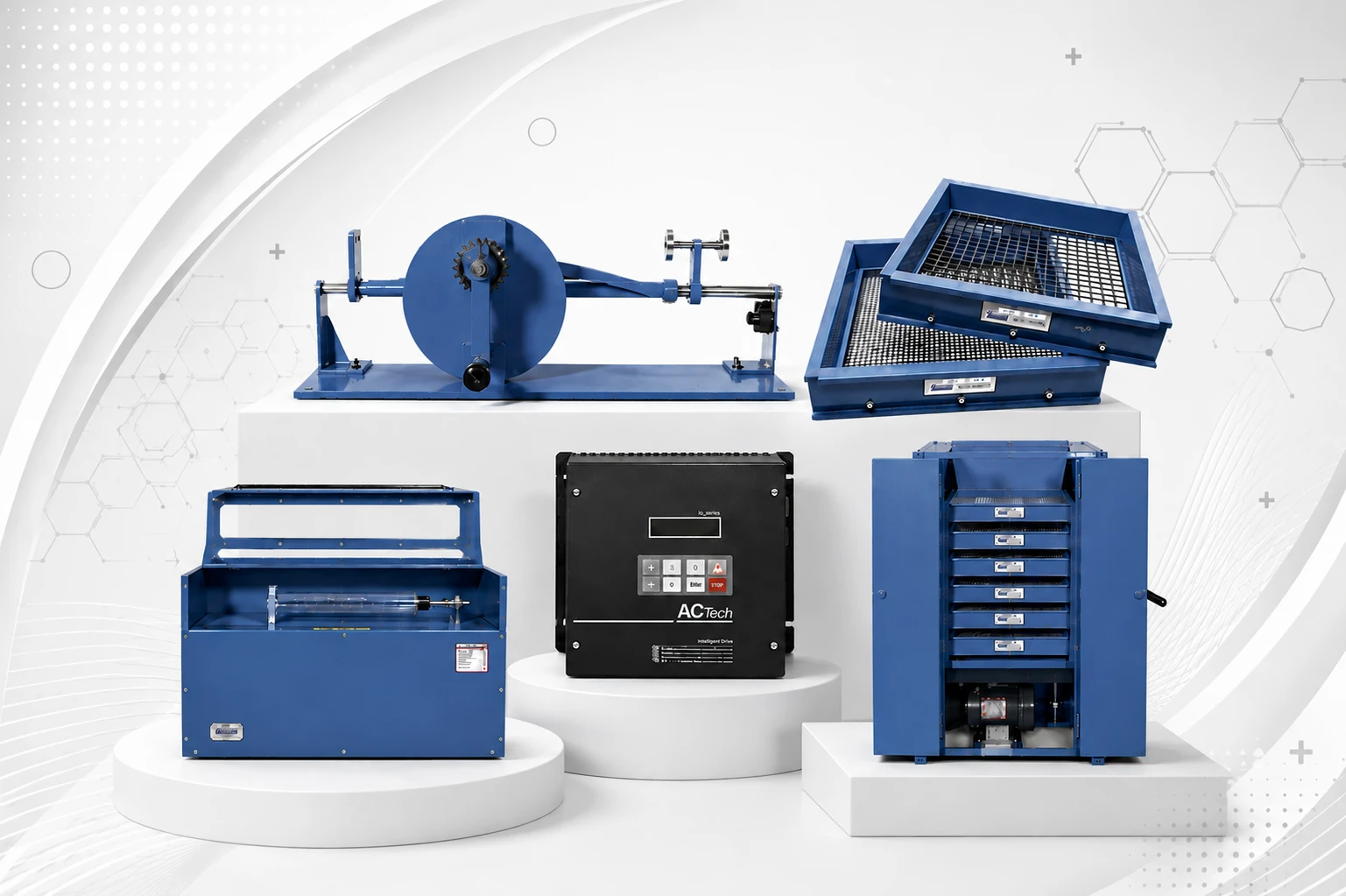
Aggregate Testing Equipment & Laboratory Supplies
Start with the Property You Need to Measure
Aggregate testing equipment helps laboratories evaluate sand, gravel and crushed stone for construction applications. The right setup depends on the property being measured, the representative sample size and the governing procedure. Use the groups below to select the equipment family before comparing individual instruments.
A screening machine, moisture tester and abrasion machine answer different questions. Choose equipment for the specified test rather than treating a broad aggregate equipment list as a complete laboratory package.
Sample Preparation: Splitters and Dividers
Use aggregate sample splitters and dividers to reduce collected material to testing portions. Compare chute width, allowable particle size, hopper capacity, enclosure and receiving pans. Match the splitter to the material condition and reduction method; equipment for dry aggregate is not automatically suitable for hot asphalt mixtures or wet, cohesive material.
Particle Sizing: Screens, Sieves and Shakers
Compare laboratory aggregate screening equipment for tray-based sizing of larger samples and aggregate test sieves for the required openings and frame sizes. Screen trays and round test sieves are different components; confirm the machine accepts the selected format.
For round-sieve testing, review aggregate sieve shakers. Compare agitation, stack capacity, clamping and timer controls. Laboratory rotary sifters provide a specialist route where that machine type suits the procedure. Select actual test equipment rather than assuming laboratory screens have quarry-production throughput.
Material Properties: Moisture, Cleanliness, Density and Durability
Choose aggregate moisture testing equipment for water-content measurements, checking the measurement principle and material suitability of each model. Sand equivalent test equipment addresses the relative proportion of clay-like fines in fine aggregate and granular soils; it is not a substitute for moisture measurement.
For relative density and absorption, compare aggregate specific gravity apparatus, separating fine-aggregate pycnometer arrangements from coarse-aggregate immersion weighing. For resistance to degradation, review aggregate durability and abrasion test equipment. Match the apparatus, charge, vessel and accessories to the required method.
Cleaning and Care: Protect the Sizing Equipment
Compare sieve cleaning brushes by their approved mesh applications and ultrasonic sieve cleaners by sieve fit, holder arrangement and approved cleaning solution. Confirm the sieve manufacturer's cleaning instructions before using either method.
Before completing an order, check included components, electrical supply, installation space and required documentation. A product listed in an aggregate category is not, by itself, confirmation of compatibility with every test method or accessory.